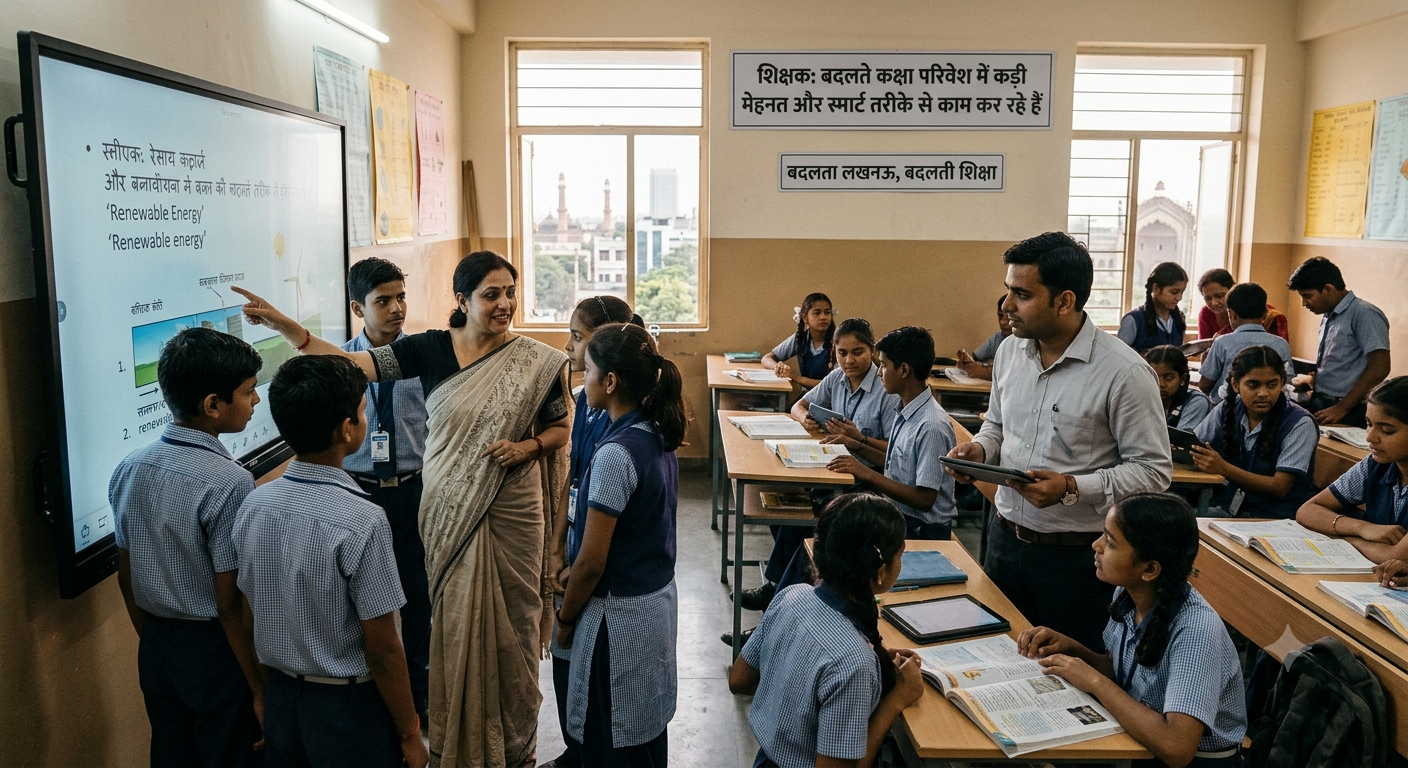
Lucknow: In the bustling educational corridors of Lucknow, a quiet transformation is taking place inside classrooms. Teachers in government, aided and council schools are moving steadily beyond the traditional chalk-and-talk approach, adapting to a learning environment shaped by technology, the National Education Policy (NEP) 2020 and a growing emphasis on experiential education.
Smart classrooms, ICT laboratories, digital learning resources and the “Learning by Doing” approach are changing the way lessons are planned and delivered. But the transition has also brought a new challenge: teachers are expected to achieve more while managing large classes, administrative responsibilities, resource constraints and, at times, non-academic assignments.

Across parishadiya vidyalayas and secondary schools—from central Lucknow to its expanding outskirts—educators are responding by working harder while also learning to work smarter. Many arrive early to prepare lessons, remain after school for remedial teaching and spend additional time creating teaching-learning material. At the same time, they are upgrading their own skills through training programmes and experimenting with digital and activity-based methods.
For teachers, the modern classroom is no longer simply a place where information is delivered. It is increasingly becoming a space where students are expected to explore, question, experiment and apply what they learn.
From Chalkboards to Interactive Classrooms
For Meena Sharma, a senior primary teacher at a composite school in the Aliganj area, the transformation is visible in almost two decades of teaching.
With nearly 18 years of experience, Sharma has witnessed classrooms evolve from conventional blackboards and textbooks to interactive digital boards and multimedia resources. But, she says, technology alone has not made teaching easier.
“Earlier, I would prepare notes the night before and deliver a lecture for around 40 minutes. Now I spend additional time designing low-cost teaching-learning materials and planning group activities,” she says.
Her approach has changed particularly in science. Instead of explaining every concept verbally, she encourages students to conduct simple experiments themselves. Household objects, locally available materials and classroom models are often converted into teaching tools.
The preparation takes time, but Sharma believes the additional effort produces deeper learning.
“When children perform an experiment themselves, they remember the concept differently. It is more demanding for the teacher, but the learning becomes more meaningful,” she says.
Her school received smart-class equipment under state programmes, and Sharma also underwent skill-based training focused on science and mathematics. Such training programmes seek to familiarise teachers with experiments, models, projects and real-life applications rather than limiting instruction to textbooks.
The change appears to be influencing student engagement as well. Sharma says attendance and participation have improved when lessons involve practical activities and digital resources.
Technology as a Teaching Assistant
The experience of Rajesh Kumar, a mathematics teacher at an upper primary school on the Gomti Nagar periphery, reflects another dimension of the changing classroom.
For mathematics teachers, abstract concepts such as geometry, fractions and measurement can be difficult to explain through conventional board work alone. Kumar has increasingly turned to ICT tools and digital demonstrations.
“There are days when non-teaching responsibilities take us away from school. When we return, we have to cover the missed academic work more efficiently,” he says.
Following block-level training on smart-class management and digital content, Kumar began using interactive boards to demonstrate mathematical concepts. He also records short explanatory videos for students who miss lessons.
Previously, he would repeatedly write examples on the blackboard. Now, a digital demonstration can be displayed to an entire class, allowing him to spend more time with students who require individual attention.
“It requires more preparation initially, but once the material is ready, teaching becomes more efficient. I can concentrate on students who are struggling instead of repeating the same explanation for everyone,” he says.
The approach is part of a wider effort to ensure that smart classrooms do not become merely decorative additions to schools. Teachers are increasingly expected to use digital infrastructure regularly and integrate it into classroom practice.
Platforms and repositories that allow educators to exchange teaching ideas are also becoming important. Teachers can access creative resources such as digital stories, activity ideas, worksheets and classroom projects developed by colleagues elsewhere in Uttar Pradesh.
For many educators, this shared pool of ideas reduces the pressure of developing every innovation independently.
Learning by Doing Gains Ground
In the secondary education sector, science teacher Sunita Verma has taken activity-based learning a step further by linking classroom lessons with issues students encounter around them.
Teaching at a government inter college near Chowk, Verma uses experiments, models and environmental themes to make science more relevant.
She also conducts voluntary Sunday sessions for students interested in practical learning.
“I try to connect experiments with issues students can see around them, including pollution and the condition of the Gomti,” she says.
The additional sessions require preparation, arranging materials and communicating with parents. Yet Verma considers them an extension of her responsibility as an educator.
One of the most rewarding moments, she says, comes when a student who was previously hesitant begins explaining a scientific concept confidently through a model that the student helped construct.
For Verma, this is the real advantage of experiential learning: students move from being passive listeners to active participants.
She has also undergone training in leadership and ICT integration and now helps younger teachers adapt to changing pedagogical expectations.
Teachers Are Learning Too
The transformation in Lucknow’s classrooms is also changing the professional expectations placed on teachers.

Educators are no longer expected merely to know their subjects. They are increasingly required to understand digital tools, activity-based pedagogy, foundational literacy and numeracy, early childhood education, classroom assessment and, in some cases, emerging areas such as computational thinking.
Training programmes conducted through state institutions and teacher-training networks are therefore becoming an important component of professional development.
The “Learning by Doing” model is particularly significant because it attempts to turn teachers into facilitators of practical learning. Instead of simply demonstrating a scientific principle, educators are trained to create situations in which students can discover and apply it themselves.
This requires a change in mindset.
A teacher who once spent an evening preparing lecture notes may now spend that same time developing a classroom activity, searching for appropriate digital resources, preparing models or designing group assignments.
In that sense, the smart classroom has not necessarily reduced teachers’ workload. Instead, it has changed the nature of the work.
The Burden Beyond Teaching
Yet the story of teacher innovation cannot be separated from the challenges facing educators.
Teacher organisations and school staff have repeatedly raised concerns about the impact of non-academic responsibilities on teaching time. Election-related assignments, surveys, administrative duties and other government responsibilities can take teachers away from classrooms.
In some schools, staffing shortages and uneven pupil-teacher ratios create additional pressure. Teachers working in peripheral areas may have to handle larger groups, multiple responsibilities and limited infrastructure.
The situation can be particularly challenging for contractual instructors and shiksha mitras, who may face financial and professional insecurity while continuing to perform important educational roles.
For teachers already spending additional hours preparing lessons and supporting students, non-teaching assignments can stretch the working day further.
This creates a difficult contradiction: the education system wants teachers to provide more personalised, innovative and experiential learning, while teachers are sometimes required to spend valuable instructional time on responsibilities unrelated to classroom education.
Small Innovations, Visible Results
Despite these pressures, teachers are finding practical solutions.
Some have formed peer-learning groups within their schools, sharing lesson plans and classroom activities. Others prepare low-cost teaching-learning materials using locally available resources. Storytelling, role-play, games, group projects and local examples are increasingly being used to make difficult subjects accessible.
After-school and weekend clubs are also being used as spaces for remedial education and skill development.
Parents and students are beginning to notice the difference.
In some schools, parents say children now return home talking about experiments and classroom activities rather than simply recalling definitions. Students who struggled with abstract concepts are finding visual demonstrations and hands-on activities easier to understand.
These may appear to be small changes, but collectively they represent a significant shift in classroom culture.
The Road Ahead
Lucknow’s government-school education system is still navigating a transition. Smart-class equipment and ICT laboratories cannot automatically guarantee better learning. Technology is useful only when teachers have adequate training, reliable infrastructure and sufficient time to use it effectively.
Similarly, activity-based learning requires materials, preparation and classroom space. Teachers need professional development that goes beyond introductory training and provides sustained support as new educational approaches become more complex.
Reducing unnecessary non-teaching responsibilities would also allow educators to devote more time to their primary role.
The larger objective, however, is clear: classrooms where children do more than memorise information.
Across Lucknow, teachers are gradually embracing this philosophy. They are experimenting with new methods, using technology selectively, sharing ideas with colleagues and spending additional hours supporting students.
Their transformation is not always visible from outside the classroom. There are no dramatic announcements when a teacher develops a new activity late at night, records a video for an absent student or stays after school to help a struggling child.
Yet these small acts represent the real transformation underway.
The teachers of Lucknow are discovering that working smarter does not necessarily mean working less. In many cases, it means investing more thought, creativity and preparation into every lesson so that the limited time available in the classroom produces better results.
The journey remains unfinished. Infrastructure gaps, staffing pressures, administrative duties and uneven access to training continue to pose challenges. But the direction is unmistakable.
The classroom of Lucknow is changing—and at the heart of that transformation are teachers willing to change with it.
They are working longer, learning continuously and experimenting boldly. Most importantly, they are demonstrating that education reform ultimately succeeds not because of technology or policy documents alone, but because teachers translate those ideas into meaningful experiences for children every day.